
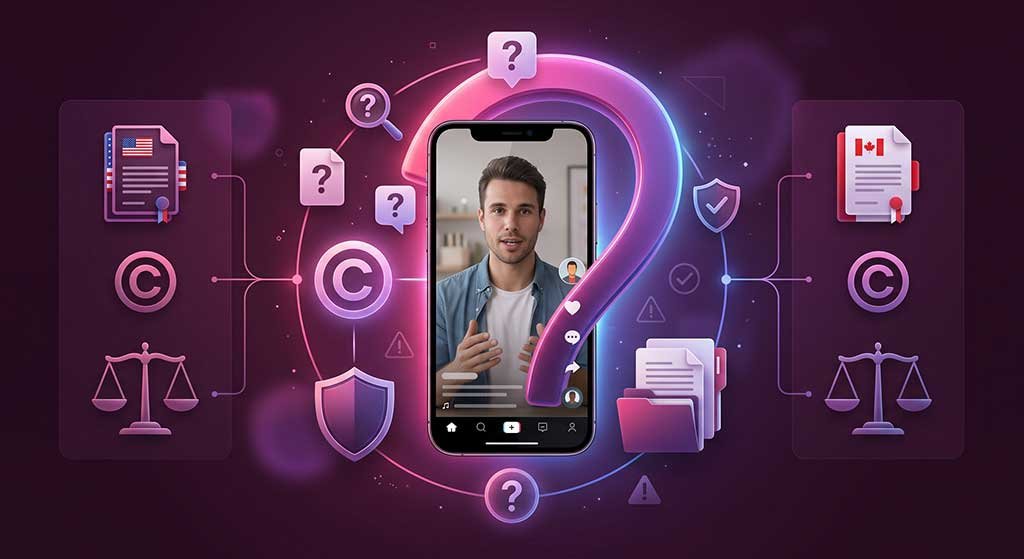
TikTok raises copyright questions at every step — downloading, reposting, using clips in other videos, remixing audio, and selling content commercially. This FAQ collects the most common questions from across the legal cluster and answers them plainly, with links to the detailed posts where you can go deeper on any topic.
Downloading TikTok Videos
Is downloading a TikTok video legal in the United States?
The answer depends on why you are downloading and what you do with the video afterward. Downloading a publicly available TikTok video for personal, private viewing is generally not the focus of copyright enforcement. Redistributing, reposting, or using someone else’s video commercially without permission is where real legal risk begins. TikTok’s Terms of Service also restrict downloading content that TikTok or a creator has disabled downloads for — though this is a contractual restriction, not a copyright issue on its own. For the full breakdown of the US legality analysis, see our guide on whether it is legal to download TikTok videos in the US.
Is downloading TikTok videos legal in Canada?
Canada’s Copyright Act governs how creative works can be reproduced and distributed. Downloading a publicly available video for private use falls under Canada’s private copying provisions in a narrower sense than often assumed — Canadian copyright has evolved significantly and private copying exceptions apply mainly to audio recordings. For creators and marketers, the key question is usually what they do with the content after downloading. See our detailed guide on Canadian copyright and TikTok downloads for jurisdiction-specific guidance.
Do I need permission to download a TikTok video?
You need permission from the rights holder to reproduce or distribute a TikTok video in most commercial or public-facing contexts. For strictly personal, private viewing, enforcement is minimal — but TikTok’s Terms of Service still require that you not use tools to circumvent their systems if they have disabled downloads for a video. Downloading a public video through a browser-based tool for personal use sits in a different risk category than reposting or commercial use.
Who owns the copyright in a TikTok video?
Copyright in the audiovisual recording belongs to the creator who made the video, from the moment it is recorded. TikTok obtains a broad platform license from creators when they agree to TikTok’s Terms of Service — that license lets TikTok distribute, display, and sublicense the content — but it does not transfer copyright ownership away from the original creator. Background music is owned separately by whoever holds the music copyright (typically a label or publisher).
Reposting and Sharing TikTok Content
Can I repost someone else’s TikTok to my account?
TikTok’s platform has a native Repost feature that shares a video to your followers while keeping it attributed to the original creator. This is permitted by TikTok’s Terms of Service. Downloading a video and then re-uploading it to your own TikTok account as if it were your content is a different matter — it violates TikTok’s Terms of Service and potentially infringes the creator’s copyright. TikTok actively enforces against duplicate content uploads.
What happens when I repost someone else’s TikTok and they file a DMCA complaint?
If a rights holder files a DMCA takedown notice with TikTok, the platform will remove the reported content and may notify you. If you receive a takedown notice, you can file a counter-notification if you believe the complaint is mistaken or that fair use applies — but filing a counter-notification without a genuine legal basis can expose you to liability. For a full walkthrough of TikTok’s DMCA process, see our guide on TikTok DMCA takedowns and reposts.
Can I share a TikTok video link without copyright issues?
Sharing a link to a publicly available TikTok video does not implicate copyright. The video remains on TikTok’s servers and is served by TikTok — you are simply pointing others to it. This is materially different from copying and redistributing the video file itself.
Fair Use and Fair Dealing
Does fair use allow me to use TikTok clips in my own videos?
Fair use (US) is a defense to copyright infringement, not a pre-authorization. It is decided case by case based on four factors: the purpose and character of the use, the nature of the original work, the amount used, and the effect on the market for the original. Commentary, criticism, education, news reporting, and parody are uses most likely to qualify. Entertainment use that substitutes for the original is least likely to qualify. There is no guaranteed formula — fair use is asserted after a claim is made and evaluated by a court or platform dispute process. For a detailed analysis of how fair use applies to TikTok specifically, see our guide on TikTok fair use and copyright.
What is fair dealing, and how does it apply in Canada?
Canada’s Copyright Act uses “fair dealing” rather than fair use. The permitted purposes are: research, private study, education, parody, satire, criticism, review, and news reporting. Courts apply a similar multi-factor analysis to the US approach. Commentary and criticism qualify; entertainment reproduction of full videos generally does not. Both countries require that the amount used be no more than necessary for the permitted purpose, and that the use not harm the market for the original. Canada’s system is generally considered narrower than US fair use in the range of qualifying purposes.
Does crediting the creator mean I can use their TikTok?
No. Credit and copyright permission are separate things. Crediting a creator acknowledges their work but does not grant you a license to use it. You still need permission from the rights holder — or a valid fair use or fair dealing defense — regardless of whether you attribute the original creator.
Music and Audio on TikTok
Can I use the music from a TikTok video in my own content?
Music in TikTok videos is licensed to TikTok for use on its platform. That license does not extend to you as a user reposting or republishing the content elsewhere. If you download a TikTok and upload it to YouTube with the original music, the music rights holder’s Content ID system will typically flag it within hours — the video may be monetized in favor of the rights holder or blocked entirely.
What happens to TikTok videos when the music is removed for copyright?
TikTok can remove a sound from a post retroactively if it is flagged for copyright infringement or Community Guidelines violations. When this happens, the video remains visible but plays silently, and TikTok shows “Sound removed” in the app. This removal applies to the TikTok copy of the video — if you downloaded the video before the sound was removed, your local copy retains the audio.
Are TikTok sounds I create myself protected by copyright?
Yes. Original audio you create and upload to TikTok — a voiceover, original music, a spoken segment — is protected by copyright from the moment it is fixed in the recording. Other users can use your sound within TikTok’s platform through TikTok’s licensed sound feature, but that does not extend to use outside TikTok without your permission.
Commercial Use
Can brands use TikTok user videos in advertising?
Using a TikTok creator’s video in an ad requires explicit permission from the creator and, if there is licensed music in the video, from the music rights holder separately. TikTok has a Creator Marketplace and UGC licensing tools that facilitate authorized commercial use, but informal use without a clear agreement creates real legal exposure. The Music Rights for Brands policy on TikTok’s business platform covers licensed music available for commercial use — not all TikTok sounds fall into this category.
I downloaded TikTok videos for a client campaign. Do I need permission?
Yes. Commercial use is one of the strongest factors weighing against a fair use defense. If a TikTok video — or audio from it — appears in paid advertising or commercial content, permission from the creator (and music rights holder where applicable) is required. Informal permission from a creator is a starting point; a written license agreement is the standard for professional use.
Platform Policies vs. Copyright Law
What is the difference between violating TikTok’s Terms of Service and copyright infringement?
TikTok’s Terms of Service govern your contractual relationship with TikTok as a platform user. Violations can result in content removal, account suspension, or termination. Copyright infringement is a legal issue under applicable law (US Copyright Act, Canadian Copyright Act) — violations can result in takedown notices, lawsuits, and damages. The two can overlap but are distinct: some actions violate TikTok’s terms without infringing copyright, and some copyright infringement occurs on third-party platforms outside TikTok’s Terms of Service entirely.
If TikTok has not taken down a video, does that mean I can use it?
No. The absence of enforcement by TikTok does not mean the content is free to use or that the rights holder has waived their copyright. Rights holders enforce selectively and at different speeds. A video that has been live for years without a takedown is still fully protected by copyright.
Watermarks and Attribution
Does removing the TikTok watermark create a copyright problem?
Removing a watermark does not itself create copyright infringement — copyright exists in the underlying video regardless of whether a watermark is present. However, removing identifying information from content before reposting it may increase the practical risk of a claim, since it removes the signal that would otherwise prompt the original creator to find and claim the repost. Watermark removal does not “clear” a video for reuse.
If I credit the TikTok creator in my caption, can I repost their video?
No — this is the same as the credit question above. Caption attribution is not a license. Some creators are willing to grant permission if asked, but that needs to happen explicitly before reposting, not be assumed based on a credit tag.
Getting Permission
How do I get permission to use someone’s TikTok video?
The most direct approach is to DM the creator explaining your intended use and asking for written permission. Be specific: state where the video will appear, whether it is commercial or non-commercial, and for how long. A screenshot or written confirmation in a message thread is informal permission; a proper license agreement is preferable for commercial or high-stakes use. Many creators grant permission for non-commercial sharing readily; commercial use typically requires negotiation.