
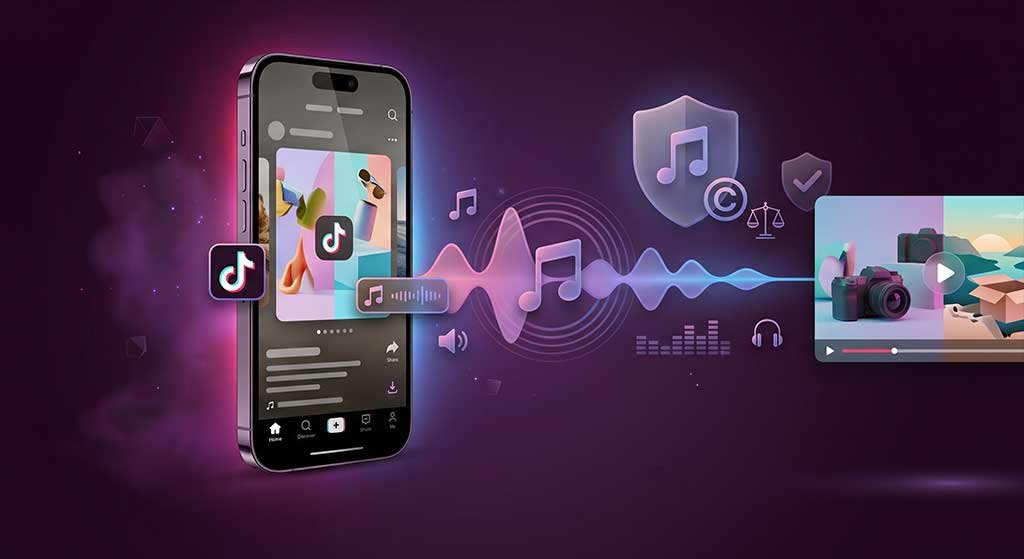
A sound that plays freely inside TikTok is not automatically cleared for use anywhere else. This is the most common music rights trap for creators — and understanding why the TikTok license stays inside TikTok is the key to avoiding it.
Why TikTok’s Licenses Are Platform-Specific
When TikTok makes a song available in its sound library, TikTok has negotiated a license with the rights holder — typically a record label and a music publisher — that permits users to sync that audio to content on TikTok. That license is specific to TikTok’s platform. It covers the act of posting a video on TikTok with that sound attached. It does not extend to:
- Downloading the audio and uploading it to YouTube, Instagram, Facebook, or any other platform.
- Using the audio in a podcast, advertisement, or commercial production.
- Distributing a recording that contains the audio outside TikTok.
- Using the audio in a video you plan to monetize off-platform.
Think of it like renting a film to watch at home. The rental license lets you watch it privately — it does not let you screen it publicly, broadcast it, or sell copies. The TikTok sound license is similarly limited to a specific context of use.
Using a TikTok Sound on YouTube: What Actually Happens
If you download a TikTok video — or just its audio — and upload it to YouTube, one of three things typically happens quickly:
- Content ID match. YouTube’s Content ID system scans uploads against a database of reference files provided by rights holders. Major-label tracks register within seconds to hours. The rights holder can choose to monetize your video (serving ads and taking the revenue), block the video globally or in specific countries, or track its performance.
- Manual DMCA takedown. If Content ID doesn’t catch it, a rights holder can file a formal DMCA takedown notice. Unlike a Content ID claim, a DMCA notice — if successful — results in content removal and a copyright strike against your channel. Three strikes leads to channel termination.
- No action, for now. Some tracks are not registered with Content ID, and some rights holders enforce selectively. No immediate action does not mean the use is cleared — it means enforcement hasn’t happened yet.
Instagram and Facebook have similar automated audio-detection systems. A sound cleared for TikTok will face the same mismatch problem on Meta’s platforms, which have their own separate licensing deals with labels.
For a detailed breakdown of how DMCA takedowns work and what to do if you receive one, see our guide on TikTok DMCA takedowns and reposts.
TikTok’s Commercial Music Library
TikTok operates two distinct music libraries:
The general sound library is available to personal accounts and allows users to add licensed music to their TikTok videos. This is the standard library most people are familiar with, and it covers organic content — posts that are not paid promotions or brand content.
The Commercial Music Library is a curated subset of tracks licensed specifically for business use on TikTok. If you have a Business Account and are creating paid promotional content, you are limited to the Commercial Music Library — the general library is not licensed for commercial purposes on TikTok itself, let alone off-platform.
Neither library grants permission to use the music outside TikTok. The Commercial Music Library extends the permitted use to brand content on TikTok; it does not extend the license to any other platform or distribution channel.
What About Original Sounds Creators Make?
Not all TikTok sounds are commercially licensed music. Many are original audio made by users — a voiceover, a spoken phrase, original music. The creator who made the audio owns the copyright in it. TikTok’s Terms permit other users to use the sound within TikTok via the “Use this sound” feature, but that permission applies only inside TikTok’s platform. Using a creator’s original sound off-platform requires permission from that creator.
Fair Use and Music: A Narrow Lane
Fair use (US) can sometimes permit limited use of copyrighted audio without a license, but music is one of the areas where fair use defenses are historically weakest. Courts applying the four fair-use factors tend to find:
- Using a song to make content more entertaining is a commercial use that weighs against fair use.
- Music is highly creative, which means it receives strong copyright protection.
- Even a small portion of a recognizable song can be found to be too much.
- If your use could substitute for the original in any market (streaming, licensing fees), that harms the rights holder’s market.
Commentary, criticism, or parody that targets the specific song may qualify — but using a song as background music or in a montage almost never does. For the full fair use framework as it applies to TikTok content, see our guide on TikTok fair use and copyright.
Royalty-Free and Licensed Music Alternatives
If you want background music in videos you post across multiple platforms, the practical path is to source audio that is explicitly licensed for your use case. Several categories of music are available:
- YouTube Audio Library. Free tracks explicitly cleared for YouTube videos, including monetized ones — available in YouTube Studio.
- Creative Commons licensed music. Check the specific license terms before using — some require attribution, some prohibit commercial use.
- Subscription libraries. Platforms that license music for multi-platform commercial content, covering as long as you subscribe (check the cancellation terms for already-published videos).
- Direct sync licensing. For advertising or commercial productions, license a specific track directly from the rights holder or through a licensing marketplace.
If you have already uploaded content with unlicensed audio and received a claim, the options are: dispute with a genuine fair use basis, mute the audio on the video, or take the video down.
Downloading TikTok Audio for Personal Reference
Some creators download TikTok sounds to identify the track name for licensing research — to find the original song, check its availability, and pursue a proper sync license. Identifying a song is not the same as clearing it. If you download TikTok audio as an MP3 to research a track, that research step does not license the audio for use in your content. You still need to obtain appropriate clearance for the platforms and uses you have in mind. For information on extracting audio from TikTok videos, see our TikTok to MP3 guide.
Frequently Asked Questions
Can I use a TikTok trending sound in my YouTube video?
Not without separate licensing. A sound available in TikTok’s library is licensed for use on TikTok only. Using it on YouTube requires either a separate license for that platform, a valid fair use defense, or choosing a sound that is explicitly cleared for YouTube use.
What if I credit the song and artist in my YouTube description?
Credit does not replace a license. Acknowledging the song and artist in a description may be good practice, but it does not give you permission to use the audio and does not prevent a Content ID claim or DMCA takedown.
If a TikTok sound has millions of uses on the platform, is it free to use elsewhere?
No. Popularity on TikTok reflects the platform-specific license, not open permission for any use. The song’s copyright is unaffected by how many TikTok videos use it.
Can I use TikTok’s Commercial Music Library sounds on Instagram?
No. TikTok’s Commercial Music Library is licensed for use within TikTok’s platform. Instagram and Meta platforms have their own licensing arrangements with music rights holders, which are entirely separate.
What happens if I upload a TikTok video to Instagram with the original audio?
Meta’s audio-detection system may flag it. Depending on the track and the rights holder, the audio may be muted, the video blocked in certain regions, or a rights claim filed against the post. The outcome depends on what deals Meta has with the relevant rights holder for that specific territory and use type.